
What Special Forces Teaches About Leading Under Psychological Pressure: Insights from Lt Col Siddhartha Vijay
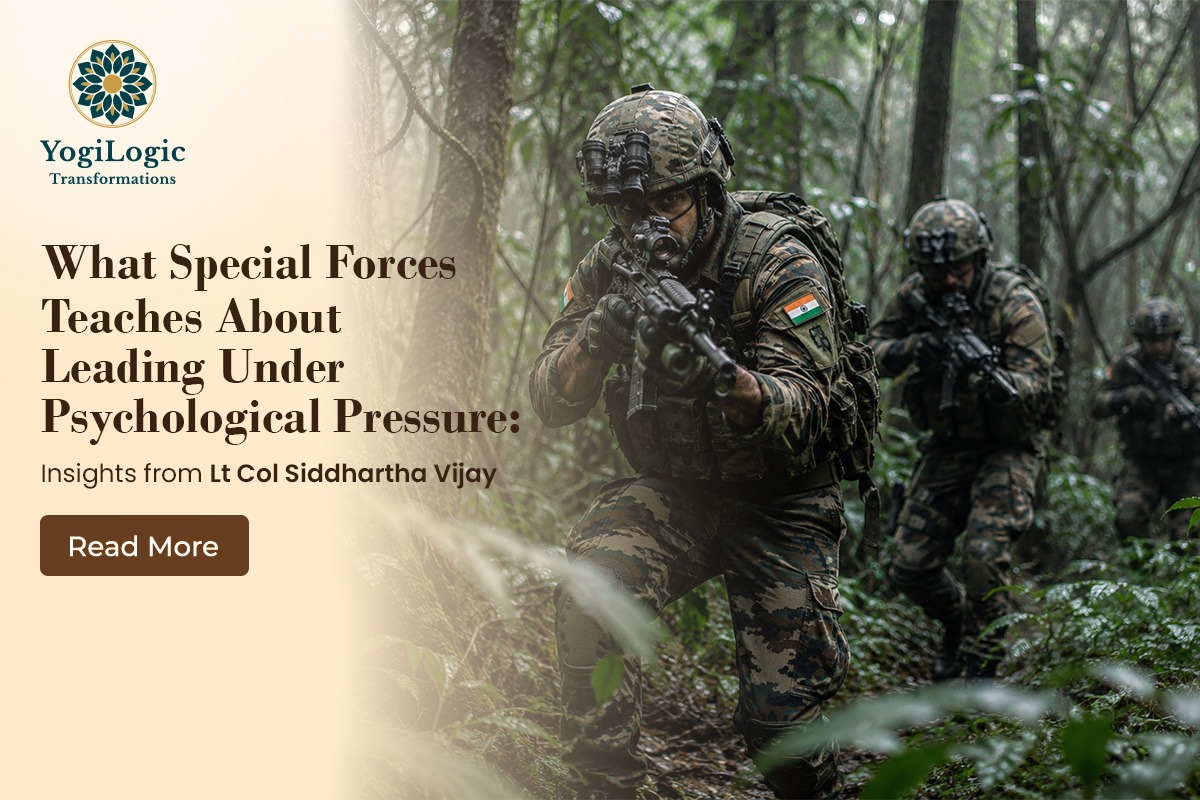
Leadership is often tested during moments of uncertainty rather than times of comfort. Whether in military operations, corporate boardrooms, healthcare environments, entrepreneurial ventures, or life itself, leaders are expected to make clear decisions while managing pressure, uncertainty, and responsibility for others.
Few environments demand psychological resilience as consistently as Special Forces. Every mission requires composure, disciplined thinking, emotional regulation, teamwork, and unwavering focus under extreme conditions.
After more than 22.5 years in the Indian Army, including service in elite Special Forces and Infantry units, Lt Col Siddhartha Vijay carried these leadership lessons into a new mission through YogiLogic Transformations. Today, as a practising psychologist, psychotherapist, and Life coach, he helps individuals and organisations build the same mental resilience that supports high performance in demanding environments.
His approach combines practical leadership experience with evidence based psychological methods to help people move from complexity to clarity.
The psychological demands of Special Forces selection and service
Special Forces personnel are not selected solely because of physical capability. Their success depends equally on psychological endurance.
Candidates operate under prolonged uncertainty, limited sleep, physical exhaustion, changing environments, and continuous decision making. Throughout these challenges, they must remain emotionally stable while supporting teammates and completing complex objectives.
Mental resilience becomes more important than momentary motivation.
The experience develops valuable psychological abilities including
- Emotional regulation
- Strategic thinking under pressure
- Adaptability
- Self discipline
- Team awareness
- Situational judgement
- Purpose driven action
- Humility
These qualities are equally valuable in civilian leadership where business uncertainty, organisational change, and personal stress create constant psychological demands.
Lesson 1 Composure is a trained skill not a personality trait
Many people believe calm leaders are simply born with natural confidence.
In reality, composure develops through repeated practice, structured training, and intentional emotional regulation.
Special Forces personnel learn to slow emotional reactions, organise thoughts, and focus attention even during rapidly changing situations. This ability is developed through disciplined preparation rather than personality alone.
The same principle applies in everyday life.
Corporate leaders facing critical business decisions, healthcare professionals managing emergencies, entrepreneurs navigating uncertainty, and individuals handling personal challenges can all strengthen emotional control through practice.
At YogiLogic Transformations, psychological techniques such as Cognitive Behavioural Therapy, Acceptance and Commitment Therapy, and Mindfulness Based Cognitive Therapy help individuals develop healthier responses to stress instead of becoming overwhelmed by it.
Composure is not about avoiding emotion.
It is about responding thoughtfully instead of reacting impulsively.
Lesson 2 Effective leadership requires knowing your team’s cognitive load
Strong leaders pay attention not only to tasks but also to the mental capacity of their teams.
Every person has a limit to how much information, responsibility, and emotional pressure they can process effectively.
When cognitive load becomes excessive, mistakes increase, communication weakens, creativity declines, and decision quality suffers and lives are lost.
Special Forces leaders continuously observe the physical and psychological condition of every team member including their own. They understand when to redistribute responsibilities, simplify communication, and maintain operational effectiveness.
Modern organisations face similar challenges.
Leaders who recognise signs of burnout, emotional fatigue, and information overload create healthier workplaces where employees remain engaged and productive.
Psychological awareness becomes a leadership advantage rather than simply a counselling skill.
Lesson 3 Decision fatigue is real and manageable
Every decision consumes mental energy.
When leaders make innumerable decisions throughout the day, mental exhaustion gradually reduces judgement, attention, and emotional balance.
Decision fatigue affects professionals across every industry.
Special Forces training addresses this challenge through preparation, structured thinking routines, clear priorities, and disciplined planning.
Many routine decisions become automatic, allowing greater mental energy for situations that truly require careful analysis.
At YogiLogic Transformations, clients learn similar strategies through evidence based psychological approaches.
These include improving self awareness, strengthening emotional regulation, developing mindful decision making, and creating practical systems that reduce unnecessary mental burden.
The goal is not to eliminate difficult decisions but to preserve mental clarity for the moments that matter most.
Lesson 4 Psychological safety within high performance teams
High performance should never depend on fear.
One of the strongest teams is one where individuals trust each other enough to communicate openly, acknowledge uncertainty, and share concerns without fear of unnecessary judgement.
Psychological safety encourages honest communication, collaborative problem solving, continuous learning, and stronger relationships.
Within Special Forces teams, trust is built through shared responsibility, mutual respect, accountability, and consistent support.
Corporate teams benefit from the same principles.
Employees who feel psychologically safe contribute more ideas, communicate problems earlier, collaborate more effectively, and remain more committed to organisational success.
Through leadership coaching and corporate training, YogiLogic Transformations helps organisations strengthen emotional intelligence alongside operational performance.
Lesson 5 The role of mission clarity in reducing anxiety
Uncertainty creates anxiety.
Clarity reduces it.
Special Forces missions begin with a clear understanding of objectives, individual responsibilities, available resources, and expected outcomes.
Even when conditions change unexpectedly, every team member understands the overall purpose guiding their actions.
The same principle applies to everyday leadership.
Individuals often experience stress because goals feel unclear, priorities conflict, or expectations constantly change.
Mission clarity provides direction during uncertainty.
Whether someone is managing a business, leading a department, changing careers, or pursuing personal growth, clearly defined purpose strengthens motivation while reducing unnecessary emotional strain.
At YogiLogic Transformations, clients explore personal values, meaningful goals, and long term purpose using evidence-based therapeutic approaches that align action with authentic priorities.
Purpose creates psychological stability during challenging times.
Translating military principles to corporate and civilian leadership
Although civilian workplaces differ significantly from military operations, the psychological foundations of effective leadership remain remarkably similar.
Successful leaders need resilience, emotional intelligence, disciplined thinking, empathy, adaptability, and effective communication.
Lt Col Siddhartha Vijay combines more than two decades of military leadership with professional psychological expertise to help organisations and individuals strengthen these qualities.
His work extends across corporate leadership development, resilience workshops, performance coaching, stress management, trauma recovery, relationship counselling, and veteran support.
The YogiLogic framework integrates structured psychological methods with mindful self awareness.
The Logic provides evidence based therapeutic tools grounded in multiple psychotherapy modalities.
The Yogi develops emotional literacy, compassion, self awareness, and inner balance.
Together they create leaders who remain effective under pressure without sacrificing empathy or personal wellbeing.
Conclusion
Special Forces leadership offers valuable lessons that extend far beyond military service. The ability to remain composed, manage cognitive load, reduce decision fatigue, build psychological safety, and maintain mission clarity creates resilient leaders in every profession.
Through YogiLogic Transformations, Lt Col Siddhartha Vijay translates these hard earned leadership principles into practical psychological tools for professionals, organisations, individuals, veterans, and families.
His unique combination of military experience and evidence based psychotherapy demonstrates that sustainable leadership is not built through pressure alone. It is developed through self awareness, emotional resilience, disciplined thinking, and compassionate leadership.
When logic and mindful self awareness work together, individuals gain the confidence to lead themselves and others through even the most demanding circumstances.
Frequently Asked Questions
What leadership lessons can civilians learn from Special Forces
Special Forces leadership teaches emotional resilience, composure under pressure, effective decision making, teamwork, adaptability, mission clarity, and psychological awareness, all of which are valuable in corporate and personal life.
How does YogiLogic Transformations apply military leadership principles
YogiLogic Transformations combines practical military leadership experience with evidence-based psychotherapy to help individuals and organisations improve resilience, leadership balance, emotional intelligence, and performance.
What is psychological safety in leadership
Psychological safety is an environment where team members feel comfortable sharing ideas, asking questions, admitting mistakes, and communicating openly without fear of unnecessary judgement.
How can leaders manage decision fatigue
Leaders can reduce decision fatigue by creating structured routines, prioritising important decisions, practising mindfulness, improving emotional regulation, and simplifying repetitive tasks.
Why is mission clarity important for reducing stress
Clear goals and defined responsibilities reduce uncertainty, improve focus, strengthen motivation, and help individuals make confident decisions during challenging situations.
Who can benefit from YogiLogic leadership coaching
Corporate leaders, business owners, managers, professionals, entrepreneurs, veterans, and individuals seeking personal growth can all benefit from leadership coaching focused on resilience, emotional intelligence, and sustainable performance.
How does psychological resilience improve leadership
Psychological resilience helps leaders remain calm under pressure, adapt to changing situations, support their teams effectively, make better decisions, and recover more quickly from setbacks.
Related Articles

Neuro-Linguistic Programming in Clinical Practice: Beyond the Myths, Into the Method
October 8, 2026
The Psychology of Military to Civilian Transition: Why Veterans Struggle and What Evidence Based Intervention Offers
October 1, 2026
The Infantry Officer's Guide to Managing Ambiguity: Psychological Lessons for Corporate Decision-Makers
September 28, 2026